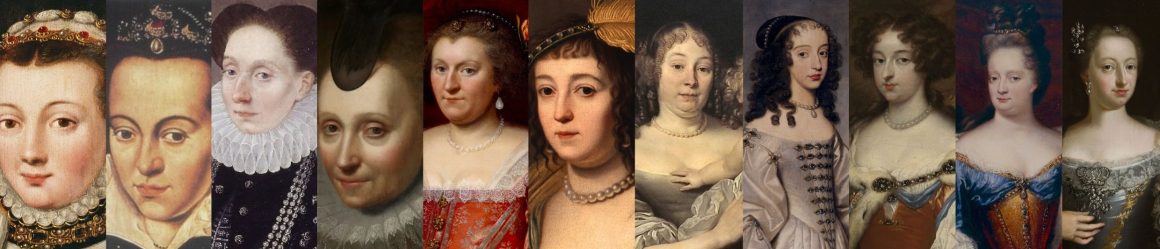
Vous pouvez croire que depuis la morte de Cromwell mes pencées ne sont employés que sur les changements qui en peuvent naitre, aussi bien en Angleterre que par deça […] C’est ce que je vous prie s’il vous plaist de me faire sçavoir si vous estes en estat de reçevoit une proposition de ma part touchant la Princesse Henriette, vostre fille […] Je sçay bien que je ne tiene pas la métode ordinairement observé en telles affaires, mais vous pouvez voir par cela l’estime que j’ay pour vostre fille et à quel point je me fie à vous.[1]
[You may believe that, since Cromwell’s death, my thoughts have been entirely occupied with the changes which may result from it, both in England and beyond […] I would therefore ask you, if you please, to let me know if you are in a position to receive a proposal from me concerning Princess Henriette, your daughter […]. I am well aware that I am not using the usual method in such matters, but you can see from this the esteem in which I hold your daughter and the extent of my confidence in you.]
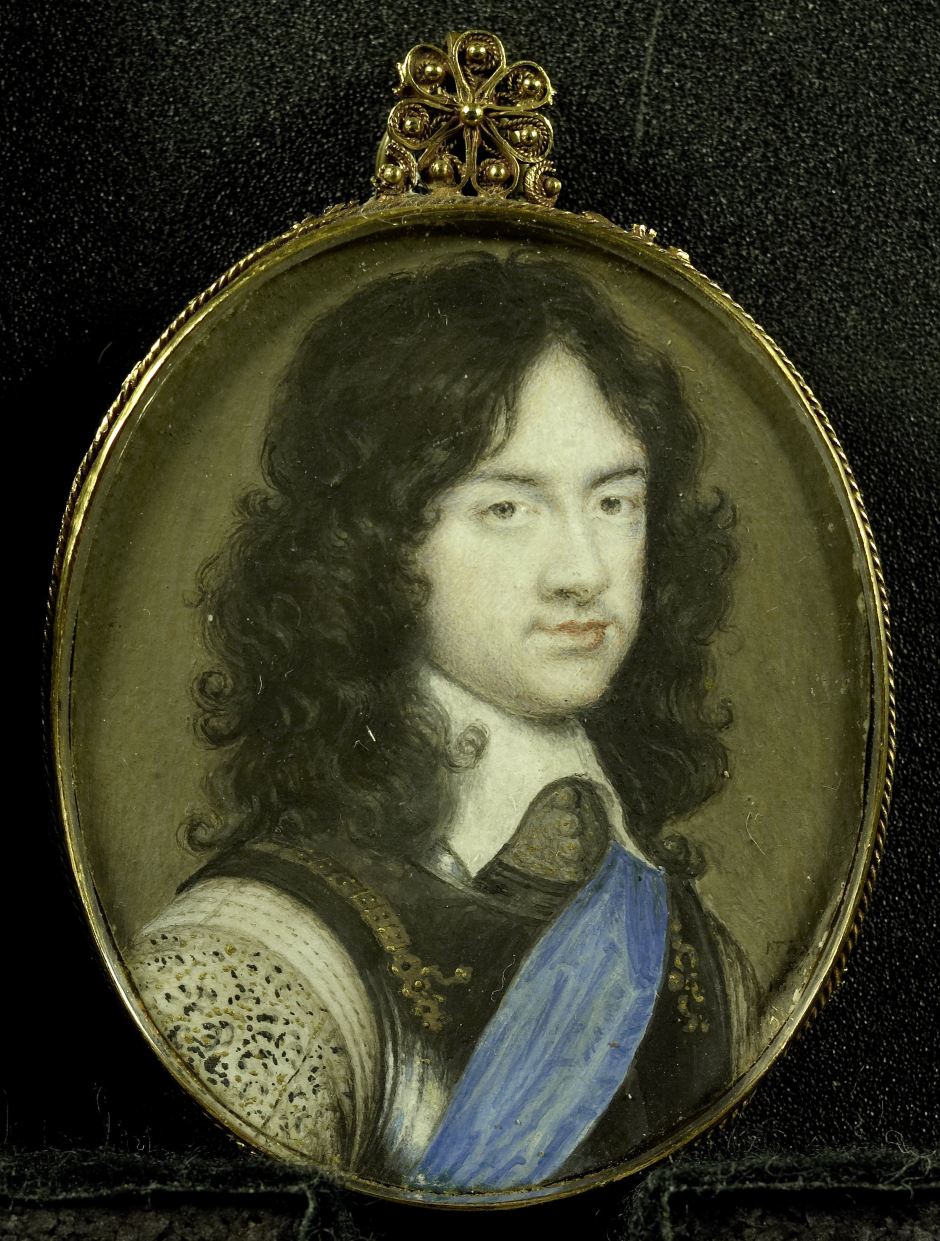
In 1646, during the English Civil War, Charles Stuart II, then Prince of Wales, fled to the continent. He spent the first few years with his brothers at the French court, accompanied by their mother Henrietta Maria, and then at The Hague. When the Republic of the United Netherlands became attached to Cromwell’s Protectorate under the Treaty of Westminster, Charles was forced to leave and spend a number of years in the Southern Netherlands, including cities such as Bruges and Brussels. Meanwhile, he was constantly on the lookout for opportunities for the restoration of the British crown. To this end, he concluded a treaty with Spain in 1656. Penniless and dependent on subsidies, Charles was continually trying to forge Stuart alliances.
Then, on 3/13 September 1658, the death of Oliver Cromwell suddenly increased Charles’s chances of ascending the British throne. He saw this as an excellent opportunity to seriously consider marriage and initiated an attempt to ask for the hand of Henrietta Catharina of Orange-Nassau, one of Amalia von Solms’ daughters.[2] Although this particular proposal by Charles Stuart has received some scholarly attention,[3] the content of the letters he sent to Amalia on the subject has never been studied. Now, for the first time, this correspondence is available in its entirety in the online catalogue of Amalia’s letters.
12 LETTERS FROM CHARLES STUART TO AMALIA VON SOLMS
It is not often that unknown autograph letters by Charles Stuart are discovered. In the early 1970s, twenty-four autograph letters written during his exile to his servant and friend Theobald Taaffe (later Lord Carlington) were found in the Osborn Collection at Yale University.[4] They were subsequently transcribed and annotated in an edition by Parks and Crist. In 1994 J.P. Vandermotten published seven letters from Charles Stuart to the Frisian Stadtholder Willem Frederik of Nassau-Dietz from the period 1650-1662.[5] These letters were found in Tresoar, Leeuwarden, Friesland. [6] Charles Stuart’s exile letters are the most interesting, as they are predominantly confidential and often written by him personally.
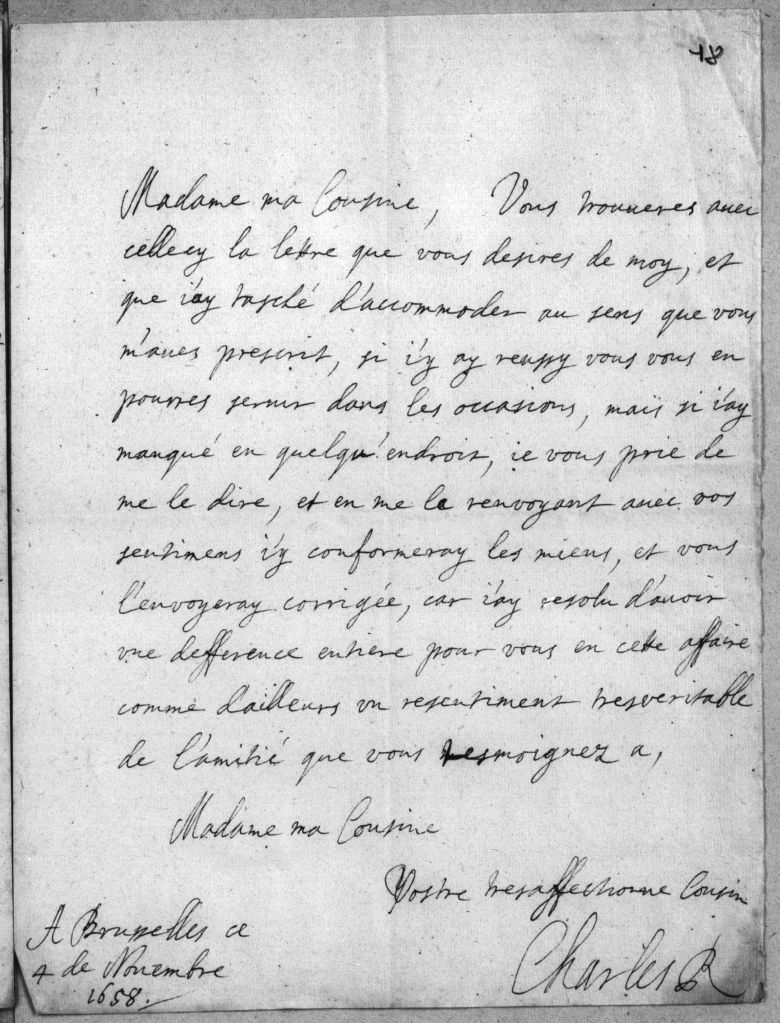
Twelve autograph letters written in French by Charles Stuart to Amalia von Solms between 1658 and 1662 have recently come to light in the Landeshauptarchiv Anhalt-Dessau [LHASA].[7] When Amalia von Solms died in 1675, her eldest living daughter Albertine Agnes (1634-1696), widow of the Frisian Stadtholder Willem Frederik, became executor of her will.[8] After Albertine’s death, a large part of Amalia’s papers, including the twelve letters of Charles Stuart, the archives of the Stadtholder William II and many Frisian documents, came into the possession of her only surviving sister, Henrietta Catharina, now the widow of the Duke of Anhalt-Dessau. These documents, together with Amalia’s paintings and jewelry, became known as the Nassauische Erbschaft and are now at LHASA.[9]
Lees verder “The Dutch Bride Hunt of Charles Stuart II” Stadhoudersvrouwen