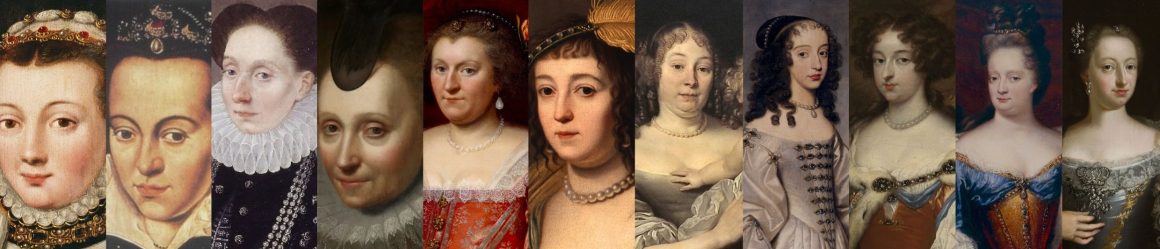
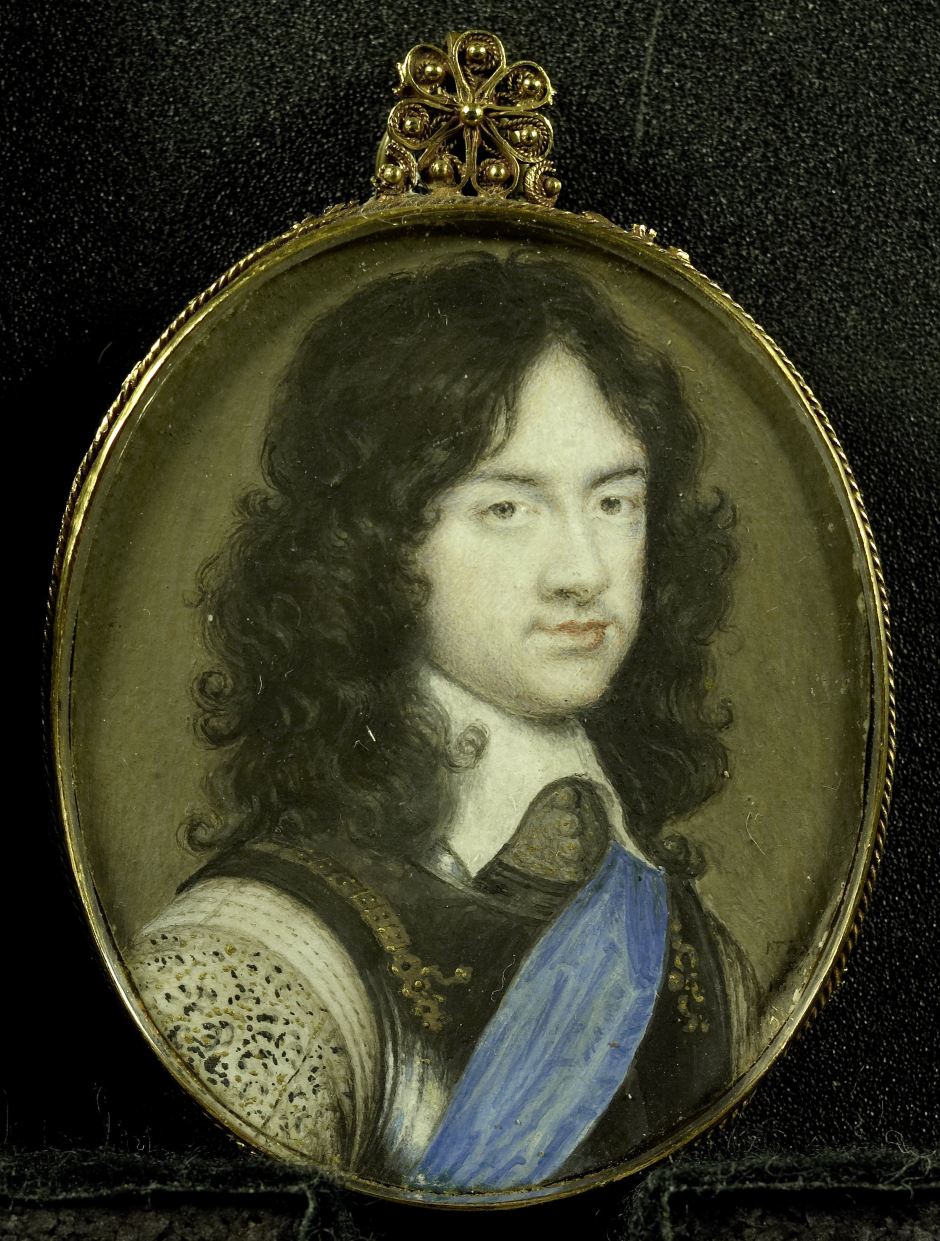
Vous pouvez croire que depuis la morte de Cromwell mes pencées ne sont employés que sur les changements qui en peuvent naitre, aussi bien en Angleterre que par deça […] C’est ce que je vous prie s’il vous plaist de me faire sçavoir si vous estes en estat de reçevoit une proposition de ma part touchant la Princesse Henriette, vostre fille […] Je sçay bien que je ne tiene pas la métode ordinairement observé en telles affaires, mais vous pouvez voir par cela l’estime que j’ay pour vostre fille et à quel point je me fie à vous.[1]
[You may believe that, since Cromwell’s death, my thoughts have been entirely occupied with the changes which may result from it, both in England and beyond […] I would therefore ask you, if you please, to let me know if you are in a position to receive a proposal from me concerning Princess Henriette, your daughter […]. I am well aware that I am not using the usual method in such matters, but you can see from this the esteem in which I hold your daughter and the extent of my confidence in you.]
In 1646, during the English Civil War, Charles Stuart II, then Prince of Wales, fled to the continent. He spent the first few years with his brothers at the French court, accompanied by their mother Henrietta Maria, and then at The Hague. When the Republic of the United Netherlands became attached to Cromwell’s Protectorate under the Treaty of Westminster, Charles was forced to leave and spend a number of years in the Southern Netherlands, including cities such as Bruges and Brussels. Meanwhile, he was constantly on the lookout for opportunities for the restoration of the British crown. To this end, he concluded a treaty with Spain in 1656. Penniless and dependent on subsidies, Charles was continually trying to forge Stuart alliances.
Then, on 3/13 September 1658, the death of Oliver Cromwell suddenly increased Charles’s chances of ascending the British throne. He saw this as an excellent opportunity to seriously consider marriage and initiated an attempt to ask for the hand of Henrietta Catharina of Orange-Nassau, one of Amalia von Solms’ daughters.[2] Although this particular proposal by Charles Stuart has received some scholarly attention,[3] the content of the letters he sent to Amalia on the subject has never been studied. Now, for the first time, this correspondence is available in its entirety in the online catalogue of Amalia’s letters.
12 LETTERS FROM CHARLES STUART TO AMALIA VON SOLMS
It is not often that unknown autograph letters by Charles Stuart are discovered. In the early 1970s, twenty-four autograph letters written during his exile to his servant and friend Theobald Taaffe (later Lord Carlington) were found in the Osborn Collection at Yale University.[4] They were subsequently transcribed and annotated in an edition by Parks and Crist. In 1994 J.P. Vandermotten published seven letters from Charles Stuart to the Frisian Stadtholder Willem Frederik of Nassau-Dietz from the period 1650-1662.[5] These letters were found in Tresoar, Leeuwarden, Friesland. [6] Charles Stuart’s exile letters are the most interesting, as they are predominantly confidential and often written by him personally.
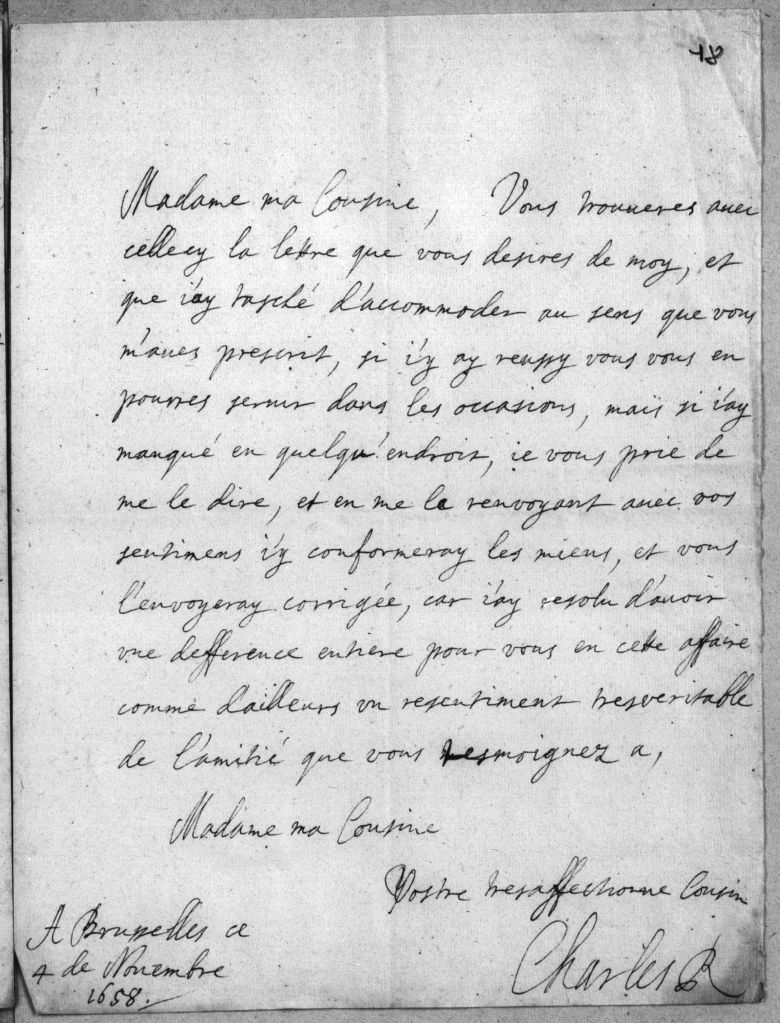
Twelve autograph letters written in French by Charles Stuart to Amalia von Solms between 1658 and 1662 have recently come to light in the Landeshauptarchiv Anhalt-Dessau [LHASA].[7] When Amalia von Solms died in 1675, her eldest living daughter Albertine Agnes (1634-1696), widow of the Frisian Stadtholder Willem Frederik, became executor of her will.[8] After Albertine’s death, a large part of Amalia’s papers, including the twelve letters of Charles Stuart, the archives of the Stadtholder William II and many Frisian documents, came into the possession of her only surviving sister, Henrietta Catharina, now the widow of the Duke of Anhalt-Dessau. These documents, together with Amalia’s paintings and jewelry, became known as the Nassauische Erbschaft and are now at LHASA.[9]
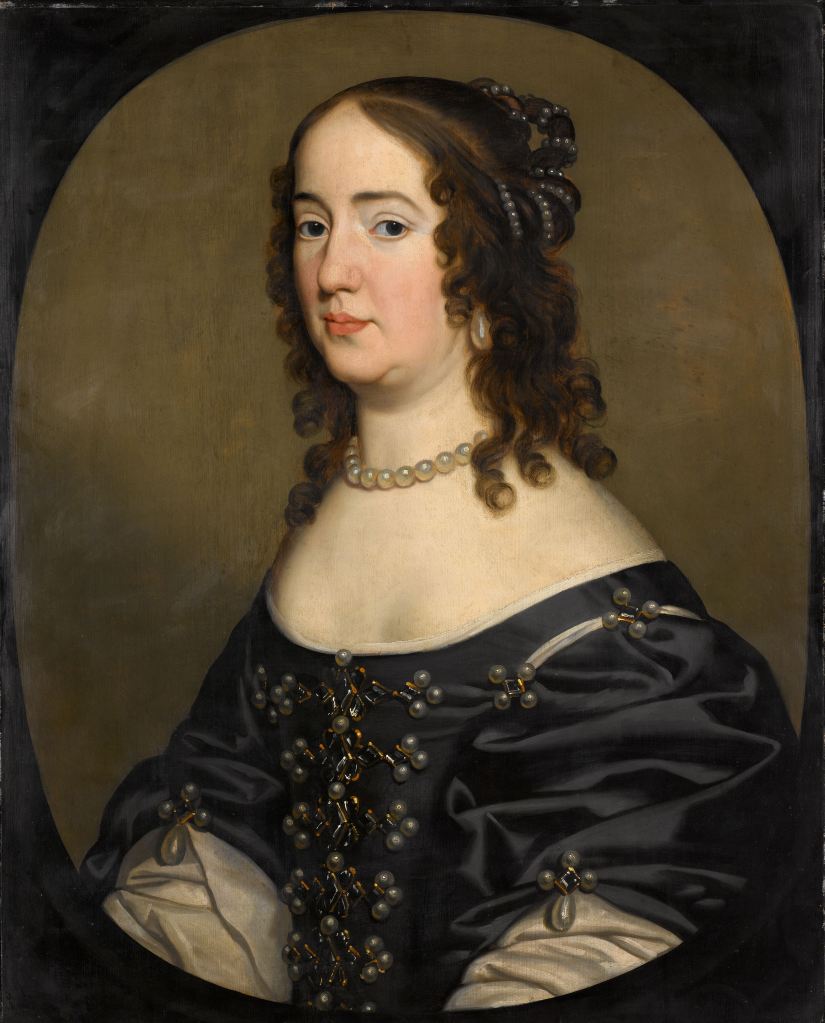
HENRIETTA CATHARINA OF ORANGE (1637-1708)
The match betwixt Mademois. d’Orange and the prince of Oost-Frise is quite broken by both their consents; neither of them ever lov’d each other, but had always an aversion one for another.[10]
With this remark, Elizabeth Stuart may have encouraged her nephew Charles to seriously consider proposing marriage to Henrietta Catharina of Oranje-Nassau.[11] At the age of four, Henrietta Catharina, one of the four daughters of Stadtholder Frederick Henry and Amalia von Solms, was engaged to Enno Lodewijk, Count of East Friesland. With the permission of the States-General, this engagement was dissolved at the end of 1656, as Henrietta Catharina had a great dislike for this count, who was known as ‘a cruel person who had killed some of his benefactors and mistreated his mother’.[12]
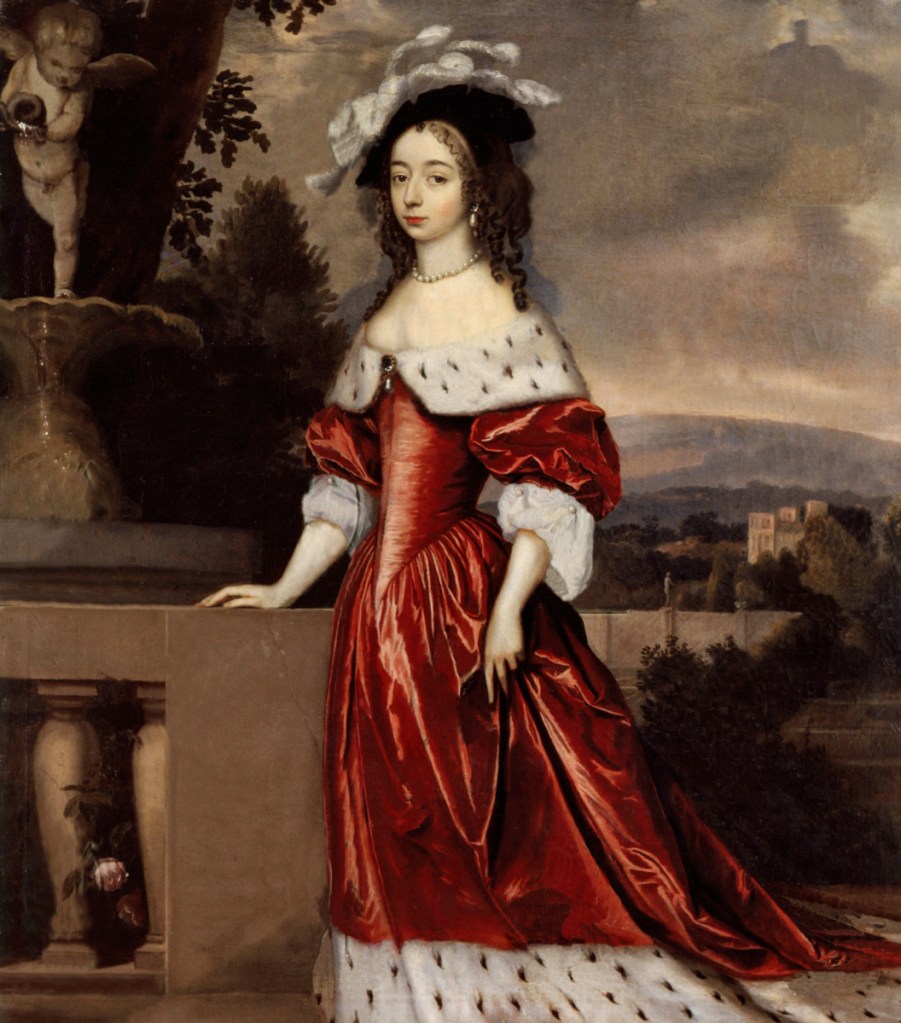
Wikimedia Commons.
In the summer of 1657, the first exploratory attempts were made to arrange a match between Johan Georg II (1627-1693) of Anhalt-Dessau and Henrietta Catharina, but nothing concrete came of them for the time being.[13] Nevertheless, in July 1659, despite Charles Stuart’s courting of Henrietta Catharina in the second half of 1658, she would indeed marry Anhalt-Dessau. The efforts of her brother-in-law, Frederick William I, Elector of Brandenburg, and his wife, Henrietta Catharina’s sister Louise Henrietta of Orange-Nassau, to bring Brandenburg, Anhalt and the Republic closer together, had been successful.[14]
DEATH OF CROMWELL: NEW OPPORTUNITIES
Charles was playing tennis with Archduke Don Juan of Austria and some other Spanish grandees when his steward, Sir Stephen Fox, brought him the news that ‘it had pleased God out of that Monster’s Death, six hours before any Express reach’d Brussels’.[15] There had been rumours for some time that the Lord Protector Oliver Cromwell was very ill, and Charles had taken several initiatives to explore the possibility of invading England. For Dutch support, Charles obviously relied more on the Orange faction than on the States-General, who were still tied to the Protectorate.
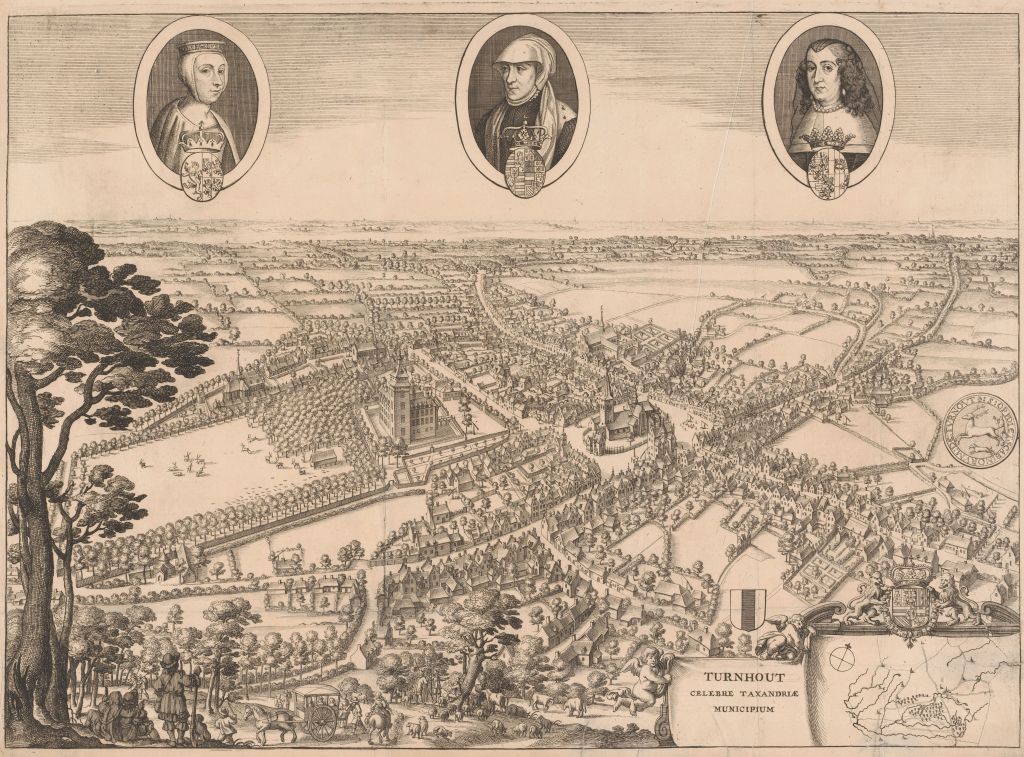
As for his female friends, Charles already had a promiscuous reputation during his exile, and by then he was the father of at least two children. But he was not yet ready to choose a serious marriage partner. From August 1658, however, he actively sought the hand of Henrietta Catharina of Orange-Nassau. In the company of her mother Amalia and her sister Maria, Henrietta Catharina often stayed at the castle of Turnhout, which had been given to Amalia in the Peace of Westphalia in 1648. It was there that Charles visited the ladies in August 1658. The distance to his temporary residence in Hoogstraten, a town on the border between the Dutch Republic and the Spanish Netherlands, where he spent his time stag hunting and hawking, was conveniently only 16 kilometres.[16] Hoogstraten was also an easy base for visiting his sister Mary when she stayed at the castle of Breda, which had belonged to the Nassaus since the 15th century.
In early September, Charles, accompanied by Henry Butler, Marquess of Ormond, and others, visited Frederik van Nassau-Zuylestein (an illegitimate son of Frederick Henry of Orange-Nassau) at his castle in Leersum. From there, via Amsterdam, he attempted to visit Count William-Frederick of Nassau-Dietz in Leeuwarden, but a storm stranded his party in Enkhuizen and Charles was forced to return and stay with his sister Mary in The Hague. Charles’s reasons for visiting both Zuylestein and Nassau-Dietz were never revealed, but it is very likely that he needed them to support his return to England. Zuylestein was to be appointed governor to Prince William III in 1659; perhaps Charles also intended to have exploratory talks about the education of his nephew William III. Alternatively, both visits may have been intended to sound out the two nobles as to whether his plans to marry Henrietta Catharina would stand a chance with Amalia.
GEORGE DOWNING
Charles’s visit to the Dutch Republic did not go unnoticed by George Downing, who was at the time an envoy of Cromwell’s Protectorate in the Dutch Republic.[17] About Charles’s secret visit Downing reported to secretary and spymaster John Thurloe ‘ that is was a journey of pleasure, and that none of the States-General nor anie person of note of Amsterdam came to him’.[18] Nevertheless, Downing complained to the States-General:
Charles Stuardt avec le Comte d’Ormond et autres de sa suitte ont esté naguères à Bois le Duc, Heusden, Suilleston et autres places et villes principales des Provinces Unies et que le Sieur Edouard Hide demeure à present en Breda là où pour quelque temps il a fait son séjour et que le lord Taaf et Neale avec plusieurs autres rebels de la République d’Angleterre sont à cett heure à La Haye.[19]
[Charles Stuart with the Earl of Ormond and others of his followers have been in Den Bosch, Heusden, Zuylestein and other main places and cities of the United Provinces and that the Sir Edward Hide remains at present in Breda, where for some time he made his stay, and that the Lord Taaffe and Neale with several other rebels of the Republic of England are at this time in The Hague.]
On behalf of the States-General, the States of Holland responded almost immediately to Downing’s protest by sending a letter to Mary Stuart ordering her to inform her brother that he was not allowed to stay in the Republic, as this was in breach of the Treaty of Westminster. Charles was ordered to leave immediately, as was Lord Chancellor Edward Hyde, who was in Breda.[20]
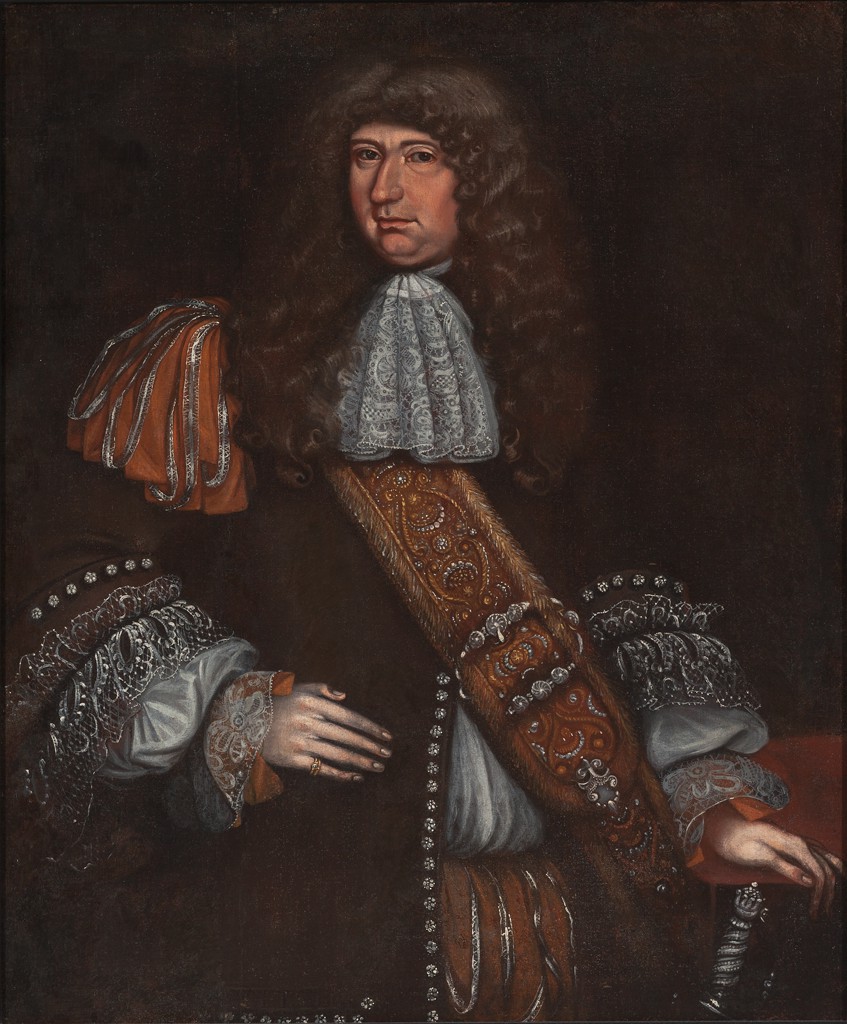
If the story told by King Charles shortly after the Restoration is true, Downing was already playing a dubious role. According to Charles’s own words, while secretly visiting his sister Mary in The Hague in September 1658, he was approached by an old man in disguise in the tavern where he was staying. On seeing Charles, the man took of his hooded cloak and identified himself as ambassador Downing. He knelt before the exiled king, begged his forgiveness and informed him that Charles’s presence in the Republic was widely known, and that he was therefore obliged to report this to the States-General, who could hand him over to the Protectorate. However, Downing assured Charles that he would slow down the process to allow him to leave.[21] Indeed, Downing was knighted in 1663 and would owe the rest of his successful career to his timely transfer and perhaps to this particular action.
A MARRIAGE CONTRACT WITH ANHALT
At Turnhout Castle, Henrietta Catharina was charmed and flattered by Charles’s advances. Charles first told her mother Amalia orally of his idea of proposing to Henrietta Catharina, who accepted it coolly and, moreover, did not mention it to her daughter.[22] This probably happened on 20 September, when Charles visited Turnhout again.[23]
In his letter of 27 September 1658, quoted at the beginning of this article, Charles made his first attempt at writing. This letter was apparently so formal that it was later printed and translated into English.[24] Amalia is said to have read Charles’s letter to Henrietta Catharina, who then fainted and had to be put to bed.[25]
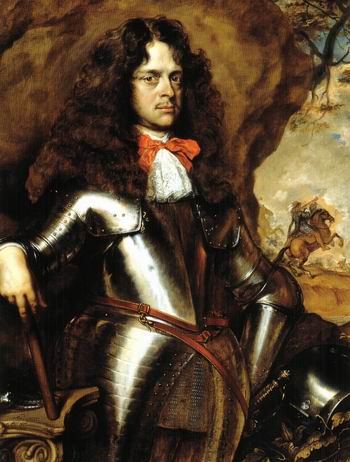
Unknown to Charles, a draft of a marriage contract between Henrietta Catharina and Anhalt had already been drawn up in Cleves on 7 September 1658, with the knowledge of Henrietta Catharina. The document literally stated that the union was ‘earnestly desired and recommended by the Elector of Brandenburg’, and copies were sent to Amalia, Henrietta Catharina, the Elector himself and William Frederick of Nassau-Dietz.[26] Amalia had probably not informed Charles of the possible match between Anhalt-Orange and Nassau, because she was still trying to assess Charles’s chances of being restored to the English throne. Obviously, it would be much better to have a daughter as Queen of England than to see her installed as Duchess of a small German state.
However, Charles’s chances seemed to be diminishing as news came from various quarters that Cromwell’s son Richard was widely accepted as his successor. Charles did not give up hope though, and continued his efforts. In the first week of October he was again ‘highly enterteyned by the old Dowager of Orange’ at Turnhout. [27] There, Amalia bought time by saying that she could not simply hand over her daughter to him without the permission of the States-General, whereupon Charles assured Amalia that he was confident of their consent.[28]
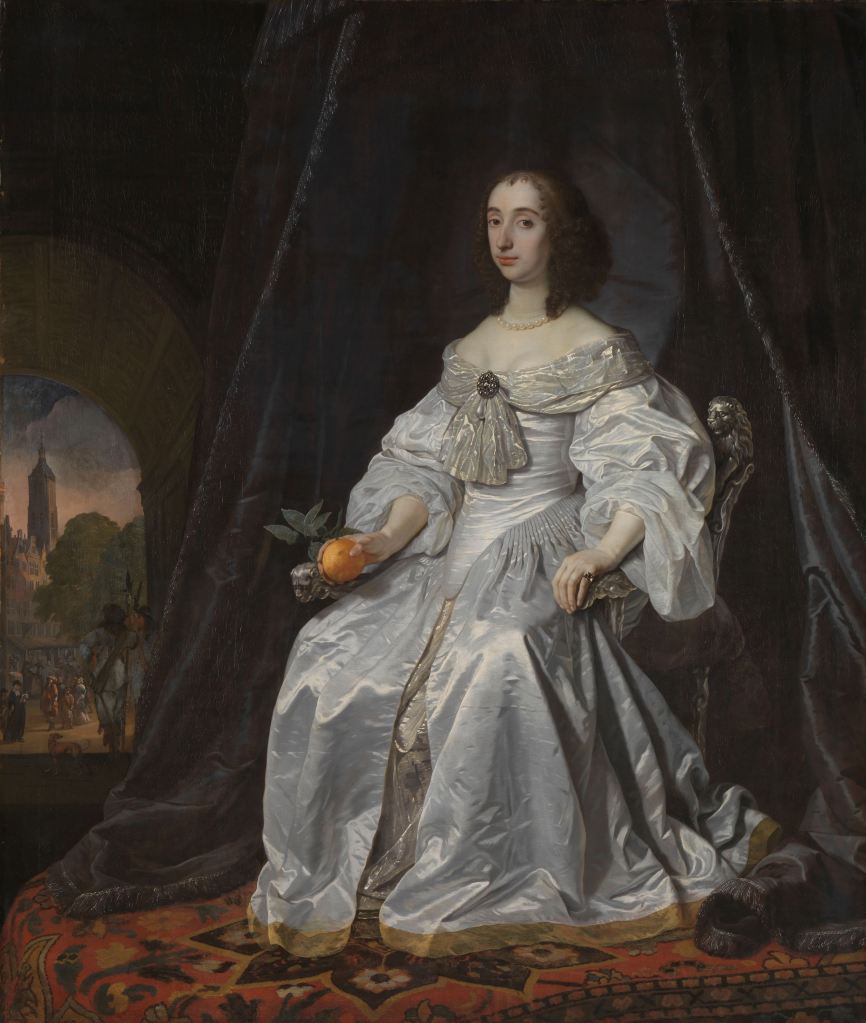
The poor relationship between Maria Henrietta Stuart and her mother-in-law Amalia, as a result of their disputes over the custody of Prince William III, had already caused considerable distrust between the two women. The affair with her sister-in-law Henrietta Catharina and her brother Charles infuriated Mary, who wrote about it to her chamberlain Johan Polyander van den Kerckhove (1594-1660), Lord of Heenvliet, on 11 October 1658.[29] The prospect of accepting her sister-in-law as future Queen of England must have been unbearable for Charles’s sister. Amalia, for her part, could not resist provoking Mary with the idea.[30]
On 21 October, referring to Amalia’s letter of 29 September, apparently written almost immediately after receiving his first letter, Charles expressed his sadness that she would not accept his proposal. It seems that nothing positive had happened between his personal visit and the writing of his last letter. Nevertheless, he drew hope from the friendship Amalia had expressed in her last letter and persisted in his request.[31] In his letter of 1 November 1658, Charles’s hopes were still high. The messenger (Ormonde) had informed him that ‘je pouvois encore espérer la conclusion d’un affaire que je désire avec tant de passion’ [‘I may still hope for the conclusion of a business deal that I desire so passionately’], he wrote to Amalia. With these words and more convincing ‘pensées’ to be delivered orally, Charles sent his servant back to Amalia in The Hague.[32]
At the same time, Ormonde himself managed to obtain permission for a marriage between his eldest son Thomas and Emilia van Nassau-Beverweerd. [33] Since Charles’s attempt to marry Henrietta Catharina would eventually fail and he would be poorer than ever, the Ormonde family donated the dowry from the marriage of Emilia and Thomas to Charles,[34] a sacrifice typical of the Ormonde family.[35]
LOST OPPORTUNITIES
Between his hopeful letter of 1 November and the writing of his letter of 4 November 1658, Charles had apparently heard from Amalia’s sources that it would be a problem to obtain the States-General’s consent to his marriage to Henrietta Catharina. He reminded her of their conversation at Turnhout in August and stressed that the States would be only too willing to cooperate with him once he was restored.[36]
There is no indication in the documents of the States-General or the States of Holland that Amalia asked for permission for her daughter’s marriage, or even for the Anhalt connection. Charles wrote to her that he was disappointed not to be admitted to the States-General, as he had interesting information to share. In fact, Charles was offering this sensitive information in return for permission to marry Henrietta Catharina. Unfortunately, what Charles had to reveal remains unknown.
Clearly, Amalia was in charge at the time, and she had the power to decide whether or not to help him. It is safe to assume that it must have been deeply humiliating for the exiled king to be dependent on Amalia’s goodwill and that of the Dutch States-General, a situation he may never have forgotten.
Charles’s letter of 4 November was accompanied by another. Charles had apparently agreed with Amalia that he would write a second letter in such a way that she could present it to the States-General.[37] At this point, would Amalia still have been seriously interested in Charles’s advances towards her daughter, and would it have been her intention to seek the States’ approval? Or was it a matter of keeping him on a leash and buying time to see what would become of his future prospects?
Charles’s letter of 14 November made it clear that Amalia had definitively rejected him as her future son-in-law. Surprised, he expressed his disappointment and insisted that he did not understand the reason for the change of heart. Nevertheless, he finally resigned, politely thanking her for her ‘bon offices’.[38]
ANOTHER ATTEMPT
Finally, sometime between 4 and 25 November 1658, Charles must have been informed that it was in the interests of the Dutch Republic and the Orange-Nassau family to strengthen ties with Anhalt, and that the Duke of Anhalt had therefore been chosen as a marriage partner. Consequently, on 25 November, Charles made the honourable decision to send a letter to Amalia for the Elector of Brandenburg, in which he is said to have explained and emphasised his interests, but also reconciled himself to the situation.[39] This letter was not one of Charles’s twelve recently discovered letters, so its exact contents remain unknown.
However, Charles did not leave it there and made another attempt. In great secrecy, he sent a letter to Henrietta Catharina in which he expressed his discomfort with the whole situation. He explained that he did not know whether her mother had informed her of his official proposals. He wrote that he had been informed that there was an engagement with another person whom Amalia preferred to him. And there he remonstrated:
S’il m’estoit permis d’y joindre mes sentimens, je dirois qu’un Roy d’Angleterre, honeste homme comme l’est celuy-ci, qoyque desthroné, vaut bien un autre Prince en possession de ses biens. C’est à Vostre Altesse à prendre ses mésures, comme elle le trouvera à propos, soit pour renouer cet affaire, ou pour la laisser en l’estat qu’elle est.[40]
[If I may add my feelings, I would say that a King of England, an honest man as this one is, albeit desthroned, is well worth another Prince in possession of his goods. It is up to Your Highness to take the measures she deems appropriate, either to renew this affair, or to leave it in the state it is in.]
In the end, Charles explained to Henrietta Catharina that that his must remain unsigned, but he concluded by saying that when better times came and she had a royal crown on her head, she would surely know the name of the sender. It was in vain, however, for Henrietta Catharina remained silent.
In his letter to Amalia of 7 December, the day on which the marriage contract between Henrietta Catharina and Anhalt-Dessau was signed in The Hague, Charles reminded her of his enclosed letter to Brandenburg 15 days earlier.[41] He assumed that she must have given it to the Elector, trusting that she would deal with it wisely. And so Charles retired with dignity.
IN VAIN
In July 1659, Henrietta Catharina was to marry the Duke of Anhalt.[42] Would Amalia and her daughter have regretted this? Amalia probably did, for she made another attempt to marry her only remaining single daughter, Maria, to Charles. In 1660 and 1661, at the instigation of the Elector of Brandenburg, secret delegations visited Charles in England to offer Maria as his bride. Charles received them politely at his restored court, but preferred to marry the Portuguese Catherine of Braganza,[43] and some resentment and malicious glee at not fulfilling Amalia’s wishes may have passed through his mind.

Henrietta Catharina would surely have been disillusioned. Yet everything had been arranged beyond her control. When she heard in November 1658 that an envoy from Anhalt had arrived in The Hague to finalise her marriage contract with Anhalt, she fell seriously ill. That was it. Her hopes of marrying Charles had definitely been dashed.[44] The fact that Henrietta kept the aforementioned letter from Charles in triplicate shows that she must have really appreciated it. Some historians claim that she took Charles’s letters with her to her grave, but this probably only concerned the private correspondence between her parents.[45]
Four other unpublished letters written by Charles in 1659-1660 in Amalia’s collection are not directly related to the affair. In these letters he described his growing prospects for the English throne. He offered courtesies and spoke in cryptic terms about ‘ce qu’en est’ and that he could not trust her with what he had to say in writing. This probably referred to his restoration and perhaps also to the education of his nephew William III.[46]
Ironically, Charles wrote to Henrietta Catharina once again on 10 December 1675. In this letter he expressed his condolences on the death of her mother, Amalia, who had died on 8 September. His servant Sylvius, who was also visiting his nephew William III, delivered the letter, which ended with Charles’s wish ‘pour vous temoigner l’interest que j’y prens, et combien j’en prendray tousjours and tout ce qui vous regarde, comme estant parfaitement, ma cousine, vostre affectionné cousin, Charles R.’ [‘to show you how much I care about it, and how much I shall always care about everything that concerns you, as being perfectly, my cousin, your affectionate cousin, Charles R.’][47] Both Charles, as he wrote these last lines, and Henrietta Catharina, as she read them, will have thought how different things might have been if only Amalia had not prevented Charles from marrying Henrietta Catharina.
CONCLUSION
In terms of her marriage policy, Amalia von Solms must be seen as powerful, calculating and opportunistic. Her choice of the most suitable candidate was closely linked to the interests of the House of Orange-Nassau, and at the time Amalia’s choice (presumably strongly encouraged by the Elector of Brandenburg) had to be a German duke. She had also been successful in finding husbands for her other children, although they did not always appreciate their mother’s intervention.
At first glance, Charles Stuart might appear to have been a pitiful victim of Amalia’s ruthless strategic actions. But from Charles’s point of view, it was not for romantic reasons that he was interested in a match with an Orange-Nassau. With his new prospects on the English throne, a marriage to a member of the Orange-Nassau family would have strengthened the Stuart-Orange dynasty and been a good investment in future relations with the Republic of the United Netherlands. After all, his sister Mary would become his wife’s sister-in-law and Amalia von Solms his mother-in-law. Most importantly, this political marriage would have made his influence on his nephew William III, possibly the future Stadtholder of the Dutch Republic, more permanent.
New sources have shown that the marriage between Henrietta Catharina and the Duke of Anhalt was arranged long before Charles made his proposals. We also now know the efforts made by the exiled king, for we have seen how modest, patient, polite and courteous he was in his attempts to convince Amalia von Solms. Now that we have the exact dates of the documents, we can also conclude that Amalia kept Charles on a leash while she calculated his chances of restoration.
And, once again, the balance of power between the Stuarts and the Orange-Nassaus was shifting. In this context, we can also better understand why, after his restoration, Charles was not interested in marrying Amalia’s daughter Maria, presumably because of the humiliating way in which he had previously been rejected. This resentment may also have played a part in the future difficult relationship between his kingdom and the Dutch Republic.
Traditionally, the practice of early modern politics has been regarded in historiography as a predominantly male affair. Moreover, in the early modern period formal and informal politics were often intermingled, as were the concepts of private and public. The study of women’s political power has thus remained elusive, under-recognised and under-utilised for many historians. Moreover, what was found in the unexplored documents relating to Charles Stuart’s proposal of marriage to Henrietta Catharina of Orange-Nassau demonstrates the importance of not only relying on previous studies, but of going back to the sources, in this case the letters of the Stadtholderswives.
Ineke Huysman, August 2023
[1] Charles Stuart to Amalia von Solms, Brussels, 27 September 1658. Landeshauptarchiv Sachsen-Anhalt (hereafter LHASA), Z 44, A 7b, 84 D 01 <emlo.bodleian.ox.ac.uk/w/974699>.
[2] In 1644, a proposed marriage between Louise Henriette, the eldest daughter of the Orange-Nassau family, and Charles Stuart II had been rejected by Amalia because of the decline of the House of Stuart. Akkerman, Courtly Rivals, 76.
[3] Geyl, Oranje en Stuart 119-20; Ronald Hutton, Charles the Second, King of England, Scotland and Ireland, (Oxford: Clarendon, 1989), 113. Hester W. Chapman, The Tragedy of Charles II in the years 1630-1660 (London: Jonathan Cape, 1964), 340-43; Derek Wilson, All the King’s Women. Love, Sex and Politics in the Life of Charles II (London: Pimlico, 2004), 123-26; Antonia Fraser, King Charles II, part one (London: Orion Publishing Co., 1989), 206-2; Eva Scott, The Travels of the King. Charles II in Germany and Flanders, 1654-1660 (London: Archibald Constable and Company, 1907), 368-69; Roger Downing and Gijs Rommelse. A Fearful Gentleman. Sir George Downing in The Hague, 1658-1672 (Hilversum: Verloren, 2011), 69-70. Timothy Crist, Charles II to Lord Taaffe. Letters in exile (Cambridge: Rampant Lions, 1974). Mary Anne Everett Green, Lives of the Princesses of England, vol. 6 (London: Longman, Brown, etc., 1857), 275-76.
[4] The James Marshall and Marie-Louise Osborn Collection, Beinecke Rare Book and Manuscript Library, Yale University, Carlingford papers OSB MSS Series I. Charles II Letters to 2nd Viscount Taaffe
[5] J.P. Vandermotten, ‘Unpublished letters of Charles II’, Restoration: Studies in English Literary Culture, 1660-1700, vol. 18, no. 1 (University of Tenessee,1994), pp. 17-26.
[6] Tresoar, Leeuwarden, Archief Willem Frederik, 13.
[7] LHASA, 84 D.
[8] Albertine Agnes correspondence in EMLO: <http://emlo-portal.bodleian.ox.ac.uk/collections/?catalogue=albertine-agnes-van-oranje-nassau>).
[9] J.N. Fernhout, Eindelijk weer samen. Inventaris van de archieven van stadhouder Willem II en Amalia von Solms en enige verwanten (Den Haag: Koninklijk Huisarchief, 2015).
[10] Elizabeth Stuart, Queen of Bohemia to Charles Stuart II, 17 January [1656], ‘Letters in possession of the Archbishop of Canterbury: 1 of 3’, in A Collection of the State Papers of John Thurloe, Volume 1, 1638-1653, ed. Thomas Birch (London: Fletcher Gyles, 1742), 661-675. British History Online http://www.british-history.ac.uk/thurloe-papers/vol1/pp661-675.
[11] Wil Tiemes, Henrietta Catharina van Oranje, in: Digitaal Vrouwenlexicon van Nederland. URL: https://resources.huygens.knaw.nl/vrouwenlexicon/lemmata/data/hcnassau.
[12] Th. Jorissen, ‘Een vorstelijk engagement’, Historische Bladen, vol. 3 (Haarlem: H.D. Tjeenk Willink, 1892), 117.
[13] Gazette de France, 1657, 703. Green, Lives of the Princesses, 258.
[14] Reinildis van Ditzhuyzen, Oranje-Nassau, een biografisch woordenboek (Haarlem: Gottmers Uitgevers groep, 1992), 141.
[15] Stephen Fox, Memoirs of the Life of Sir Stephen Fox (London, 1717), 29.
[16] Scott, The Travels of the King, 367.
[17] George Downing resided in The Hague in 1658-1659. After the Restoration he reconciled with the King and returned to the Dutch Republic several times as an extraordinary ambassador.
[18] George Downing to secretary Thurloe, 11 October 1658, in A Collection of the State Papers of John Thurloe, Volume 7, March 1658 – May 1660, ed. Thomas Birch (London, 1742), pp. 417-429. British History Online <http://www.british-history.ac.uk/thurloe-papers/vol7/pp417-429>.
[19] Downing’s Memorial against receiving rebels etc. into the United Provinces, 10 September 1658, National Archive The Hague [NA], 1.01.02 Staten-Generaal, 12576.71.
[20] States of Holland to Mary Stuart, 7 September 1658, NA, 3.01.01.04 Staten van Holland, 1396 <emlo.bodleian.ox.ac.uk/w/974698>.
[21] Scott, The Travels of the King, 368; Green, Lives of the princesses of England, vol. 6, 270-71.
[22] Chapman, The Tragedy of Charles II, 341.
[23] Ormonde and Bellings to Hyde 9/19 September 1658, F.J. Routledge, Calendar of the Clarendon State Papers, vol. IV (Oxford: Oxford University Press, 1932), 77-78.
[24] Thomas Carte, A Collection of Original Letters and Papers concerning the Affairs of England from the Year 1641 to 1660. Found among the Duke of Ormond’s, vol. II (London: James Bettenham, 1739), 154-57 <emlo.bodleian.ox.ac.uk/w/974699>.
[25] Scott, The Travels of the King, 369.
[26] Draft of marriage contract between Henrietta Amalia of Oranje-Nassau and Johan Georg II of Anhalt-Dessau of 7 September 1658, LHASA, Z 44, A 7b, 126M.
[27] Downing to Thurloe, 11 October 1658, Thurloe Papers, VII, 421.
[28] Chapman, The Tragedy of Charles II, 342.
[29] Mary Stuart to Heenvliet, 11 October 1658. Oxford – Bodleian Library [OBL], Ms Rawl Lett 115, 298-303 <emlo.bodleian.ox.ac.uk/w/954324>.
[30] French ambassador in the Dutch Republic Jacques-Auguste de Thou to Henri-Auguste de Loménie, count of Brienne, French secretary of State, 7 November 1658, British Library (BL), Harl. Ms. 4527. Green, Lives of the Princesses, 256.
[31] Charles Stuart II to Amalia von Solms, Brussels 21 October 1658, LHASA, Z 44, A 7b, 84D 02, <emlo.bodleian.ox.ac.uk/w/974700>.
[32] Chapman, The Tragedy of Charles II, 341.
[33] Emilia, daughter of Lodewijk van Nassau-Beverweerd, (governor of ‘s-Hertogenbosch and special envoy to England in 1660), would be become Countess of Ossory and future lady-in-waiting of Queen Catharina of Braganza. Her sister Elizabeth would marry Henry Bennet, Earl of Arlington in 1665.
[34] Carte, The Life, vol. III, 673-75.
[35] Chapman, The Tragedy of Charles II, 342.
[36] Charles Stuart to Amalia von Solms, Brussels 4 November 1658, LHASA, Z 44, A 7b, 84D 04, <emlo.bodleian.ox.ac.uk/w/974702>.
[37] Charles Stuart to Amalia von Solms, Brussels 4 November 1658, LHASA, Z 44, A 7b, 84D 05, <emlo.bodleian.ox.ac.uk/w/974703>.
[38] Charles Stuart to Amalia von Solms, Brussels 14 November 1658, LHASA, Z 44, A 7b, 84D 06, <emlo.bodleian.ox.ac.uk/w/974704>.
[39] Charles Stuart to Amalia von Solms, Bruxelles 25 November 1658, LHASA, Z 44, A 7b, 84D 07, <eemlo.bodleian.ox.ac.uk/w/946865>.
[40] LHASA, Z 44, A 10, 94 Bd I, three manifestations of the same unsigned and undated letter to Henrietta Catharina, princess of Orange-Nassau [to be published in EMLO].
[41] Charles Stuart to Amalia von Solms, Bruxelles 7 December 1658, LHASA, Z 44, A 7b, 84D 08, <emlo.bodleian.ox.ac.uk/w/974705>.
[42] Wil Tiemes, Henrietta Catharina van Oranje, in: Digitaal Vrouwenlexicon van Nederland. https://resources.huygens.knaw.nl/vrouwenlexicon/lemmata/data/hcnassau.
[43] F.W. van den Berg, ‘Maria van Oranje (1642-1688) in: Jaarboek Oranje-Nassau Museum (1993), 10.
[44] French ambassador in the Dutch Republic Jacques-Auguste de Thou to Henri-Auguste de Loménie, count of Brienne, French secretary of State, 28 November 1658, BL, Harl. Ms. 4527.
[45] Akkerman, Courtly Rivals in The Hague. Elizabeth Stuart & Amalia von Solms (Venlo: VanSpijk/Rekafa Publishers BV, 2014), 103. Original copy of Henrietta Catharina’s will, 20 October 1707, RC A14, XIV D4.
[46] Charles Stuart to Amalia von Solms, Bruxelles 29 December 1659, LHASA, Z 44, A 7b, 84D 9, <emlo.bodleian.ox.ac.uk/w/946866>); 15 February 1660, LHASA, Z 44, A 7b, 84D 10, <emlo.bodleian.ox.ac.uk/w/946867>; 18 April 1660, LHASA, Z 44, A 7b, 84D 11 <emlo.bodleian.ox.ac.uk/w/946868> 23 April 1660, LHASA, Z 44, A 7b, 84D 11 <emlo.bodleian.ox.ac.uk/w/946869>.
[47] LHASA, Z 44, A 10, 84, 5. Charles Stuart II to Henrietta Catharina von Anhalt-Dessau, 10 December 1675 [to be published in EMLO].
 Stadhoudersvrouwen